
India’s Solar Thermal Industry Call: What Changes for Process Heat
India has opened a defined proposal window for concentrating solar thermal technology in industry. The notice is a route to pilot projects and evidence, not a blanket payment for every industrial energy user.
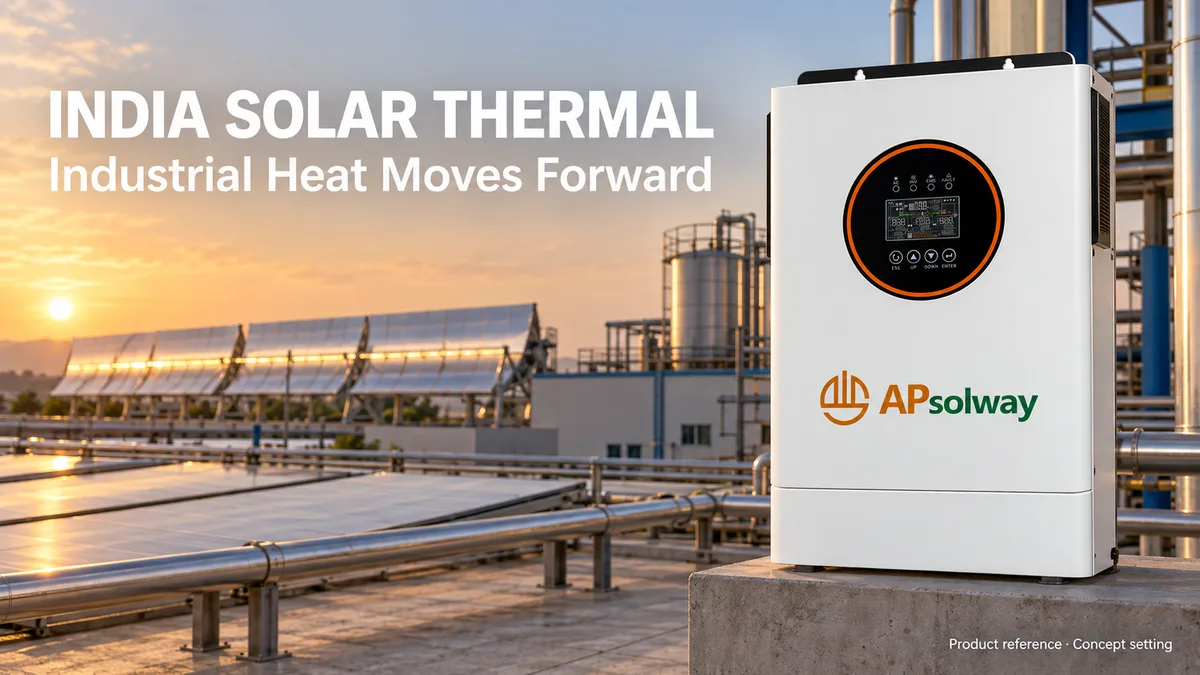
What MNRE has opened
India’s Ministry of New and Renewable Energy (MNRE) published a call for proposals on 8 September 2026 for concentrating solar thermal (CST) technology in Indian industry. Proposals are due by 7 October 2026 through the ministry’s research portal. Read the MNRE call for proposals.
The programme sits under the Renewable Energy Research and Technology Development (RE-RTD) programme. MNRE is looking for projects that can connect solar heat with a real industrial process, thermal energy storage (TES) and, where needed, a hybrid heat source. The intended result is evidence on technical performance, economics, fossil-fuel displacement and the ability to repeat the model at other sites.
The notice covers several temperature ranges
The indicative routes include parabolic trough systems for about 60°C to 400°C process heat, linear Fresnel systems for about 60°C to 250°C, parabolic dishes for about 100°C to 500°C, and power towers for about 150°C to 600°C. The notice also mentions PV-coupled heat pumps for heat around 90°C or more, together with CST and storage for supplying heat outside sunshine hours. The list is not exhaustive, so the temperature range should be treated as a starting point for site assessment.
MNRE expects the proposal work to examine the process temperature, heat demand, current fossil-fuel use, possible fuel substitution, solar resource and techno-economic feasibility. A selected pilot is expected to show integration with the existing heating system, reliability, fuel savings and operating economics. The technology provider or system integrator is also expected to cover site assessment, design, installation, commissioning, training and performance monitoring, with at least five years of operation and maintenance.
What the support actually means
The call allows partial capital support of up to 50%, capped at ₹2.00 crore per project, depending on the project and its potential for adoption. It may be structured as viability-gap funding. Industries, start-ups, private institutes and entrepreneurs can apply, and a beneficiary industry may participate in a consortium.
The beneficiary still needs to provide a suitable process-heat application and site, baseline and operating data, access and approvals, its share of project cost, and support for installation and monitoring. This is why the notice should be read as a project-selection opportunity. It does not confirm that every factory, every heat load or every equipment configuration will receive support.
What industrial energy users need to check
A site with a steady daytime heat demand may use solar heat differently from a site whose main load continues after sunset. TES or a hybrid source may help a process that cannot pause, while a simpler daytime application may need less additional equipment. The useful comparison is the site’s actual temperature, operating schedule, heat demand, fuel use, available area, access and the full installed cost.
The notice also gives more weight to measured results. Applicants are expected to document capacity, performance, economics and fossil-fuel savings, while the programme aims to create repeatable business models and guidance. That can improve future project decisions, but it does not promise a fixed payback period or a fixed reduction in energy costs for every facility.
APsolway’s approach is to relate equipment selection to the site’s heat profile, continuity requirements and installation environment. Exact model suitability and local approvals require separate technical confirmation.