
India Green Energy Corridor III: Transmission, Storage and Electricity Demand
India’s September 30, 2026 approval of Green Energy Corridor Phase III brings transmission networks and battery storage into one programme. For electricity users, it provides a useful basis for understanding how renewable generation reaches the point of use and how its timing can be managed.
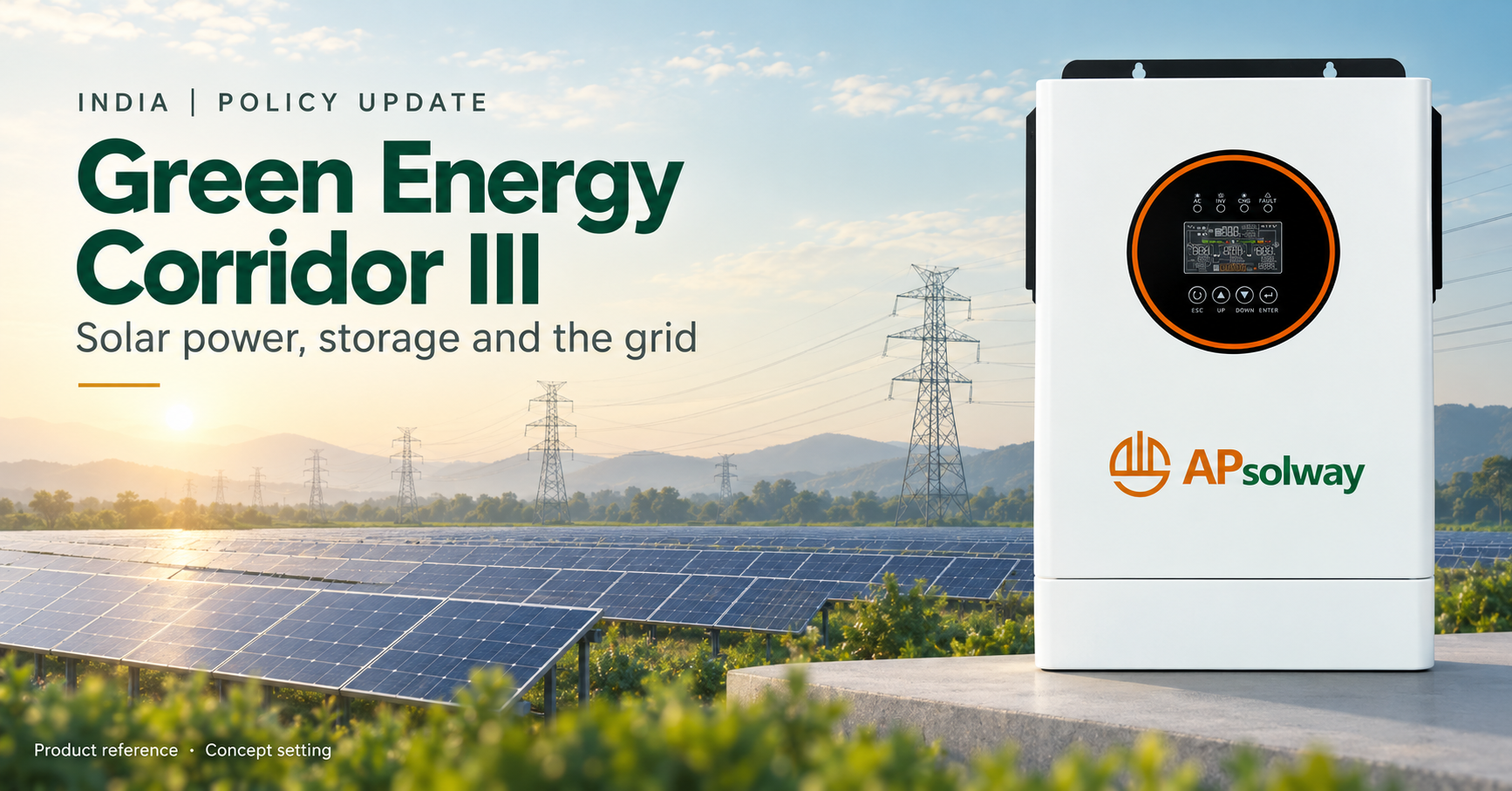
The approved programme
The plan aims to strengthen intra-State transmission to carry electricity from up to 135 GW of renewable generation, alongside 50 GWh of battery energy storage. Batteries can be installed at renewable generators or other locations that support grid flexibility. The target implementation horizon is FY 2032–33.
The total announced outlay is ₹1,86,405 crore, including ₹1,36,378 crore for transmission and ₹50,000 crore for batteries. Central financial support is ₹54,082 crore. State Transmission Utilities oversee implementation: new transmission projects use tariff-based competitive bidding, while upgrades and network strengthening follow a cost-plus approach. Cabinet announcement, 30 September 2026.
These are approved programme targets and funding arrangements. They do not establish a particular user’s tariff, battery subsidy, equipment eligibility or application deadline.
Storage has different roles in the electricity system
The August 2023 National Framework for Promoting Energy Storage Systems describes storage across generation, transmission and distribution. At a generating project, storage can make renewable supply more controllable and reduce production that cannot be used. Within a network, it can help relieve congestion and improve utilisation. Near electricity demand, it can help manage peaks and shift the timing of consumption.
The framework also identifies efficiency, useful life, depth of discharge and the relationship between power and energy capacity as relevant performance measures. These provide a more complete basis for understanding a battery system than its capacity label alone. Ministry of Power, section 4.
Power describes the output that can be delivered at a moment in time; energy describes the amount available over a period. The programme’s GWh figure is an energy target, rather than a statement of output or operating duration for every installation. Announced future capacity should also be distinguished from equipment already operating.
Start a site assessment with the operating schedule
APsolway’s analysis is that an electricity assessment needs to connect equipment choices with the way a site operates. Annual energy use gives an overall total, but it does not show the hours when equipment needs power or which loads must remain available.
For example, a site operating mainly during daylight has a different demand pattern from one running into the evening. Even with similar annual consumption, their overlap with solar production can differ. Storage requirements would depend on the energy needed outside the period of direct solar production, as well as the output required at those times.
This is a qualitative illustration, not a forecast of savings. A comparison becomes more useful when both proposals use the same operating hours, essential loads and supply objectives. Otherwise, two different system designs can appear comparable simply because they carry similar capacity labels.
For APsolway’s inverter options, the intended function should be defined before a model is selected. Connection conditions, verified model documentation and the installation design must then be considered together. A product photograph does not establish a specification, local approval or entitlement under a public programme.
Keep backup requirements explicit
The U.S. Department of Energy explains that solar needs a properly configured inverter and storage system to operate independently during an outage. Its resilience guidance describes how local generation, storage and microgrids can support essential services when the wider network is disrupted. These are engineering considerations, not Indian programme rules. DOE: Solar and Resilience Basics.
A site that needs continuity of supply should identify the equipment to be supported and the required duration. The design can then distinguish ordinary operation from an interruption to normal supply. Grid investment does not, by itself, confirm the backup behaviour of equipment installed at a particular site.